TRANSFER PRICING · APR 2026 · 8 MIN READ移転価格 · 2026年4月 · 読了8分
Can you explain the price behind your intercompany transactions?
Goods from Japan HQ, management fees, royalties, loans — related-party transactions happen every month. Their prices affect U.S. profit, tax and what headquarters sees. Being able to explain them is the starting point.
日本本社との取引価格、
その根拠を説明できますか?
日本本社から商品を仕入れている。経営指導料を支払っている。グループ会社から技術提供を受け、ロイヤルティを支払っている。こうした取引は日系企業の米国子会社にとって一般的です。しかし、その価格がどのように決められているか、説明できるでしょうか。
1. What transfer pricing means
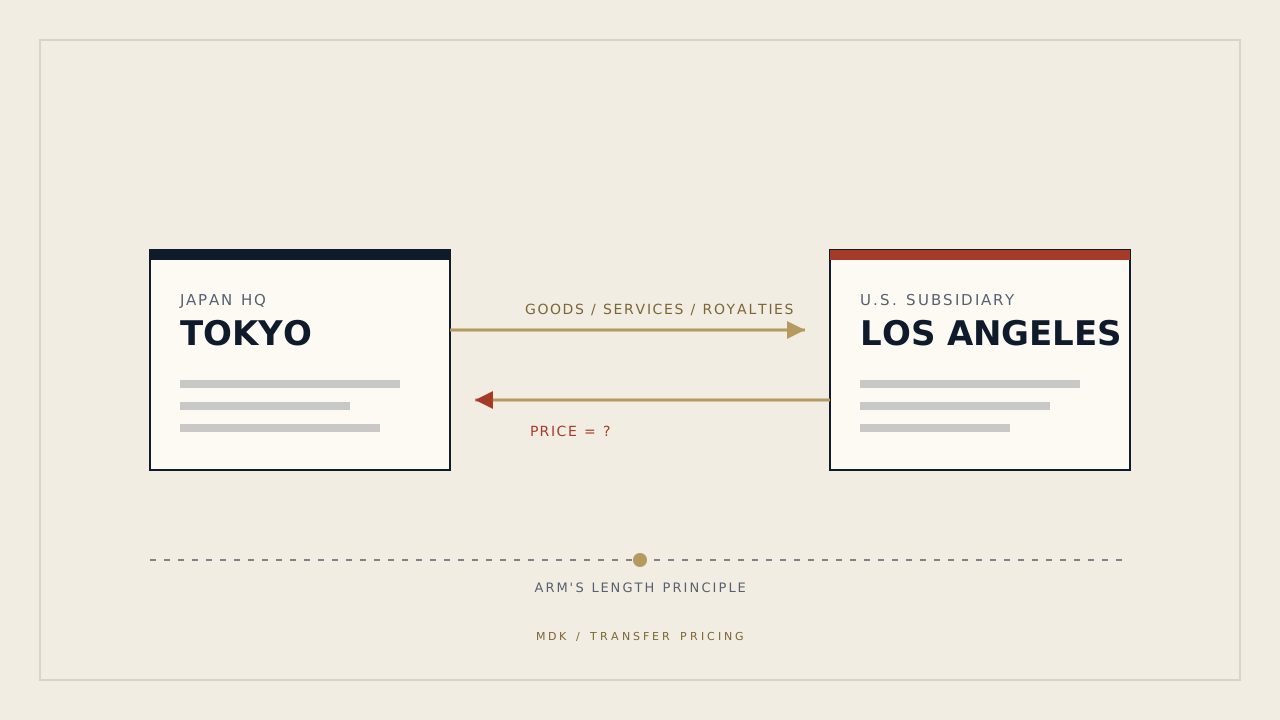
Transfer pricing is the price set when related companies trade goods, services, intangibles or funds. U.S. tax law — IRC Section 482 — allows the IRS to adjust income between related parties, and the organising principle is arm's length: what independent parties would have agreed to under comparable circumstances.
That does not mean applying an industry-average margin. It means analysing what each company actually does, what assets it uses, and which risks it bears, then supporting a price that fits those facts.
2. The price changes the profit — on both sides
A simple example. Japan HQ sells a product to the U.S. subsidiary for $80; the U.S. subsidiary sells it to a customer for $100. Its gross profit is $20.
If the price becomes $90, U.S. gross profit falls to $10. If it becomes $70, gross profit rises to $30. The same end-customer price produces very different results in the U.S. and Japan. This is why a transfer price is a management question as much as a tax question.
Figures are illustrative only. The right price depends on the facts.
3. The right margin depends on the role
Two sales subsidiaries can look identical in revenue and still warrant different profit levels:
Case A — limited-function distributor. Japan HQ develops the product, sets strategy and carries most of the risk. The U.S. company performs a limited sales function. A modest, stable return may be appropriate.
Case B — full-function distributor. The U.S. company holds inventory, negotiates prices, markets, bears credit risk and handles customers. It carries more functions and risks, so the analysis and the expected return differ.
4. What a transfer pricing study is for
A study documents the transaction, the functions-assets-risks (FAR) analysis, comparable transactions or companies, the selected method and the support for the price. It is not a one-time filing exercise. U.S. rules can impose penalties where a taxpayer fails to prepare and retain adequate documentation, so the file needs to exist before it is requested — and it needs to match how the business actually operates.
5. The facts change; the policy has to keep up
A study becomes stale when the U.S. company takes on inventory risk, expands marketing, starts a new intercompany service, or HQ changes the terms. Reviewing pricing and margins monthly or quarterly — not only at year-end — catches drift early. If profits are persistently below the policy, the reason may be transfer pricing, not sales performance.
6. Transfer pricing is also a management issue
When the intercompany price is not explained, HQ can misread the U.S. subsidiary: a low margin may reflect the price, not weak execution. A defensible pricing policy gives both sides a common basis for judging profitability, budgeting and investment — and a clearer conversation about where the business is actually making money.
The point is not to move profit between countries. It is to be able to explain a price that fits each company's real functions, risks and terms.
MDK supports transfer pricing studies, FAR analysis, documentation updates and the ongoing management of intercompany pricing — in Japanese and English, alongside the accounting and HQ reporting work.
1. 移転価格とは何か
移転価格とは、グループ会社間で商品、サービス、無形資産、資金などを取引する際に設定する価格を指します。米国内国歳入法第482条では、一定の関連者間取引について、税務当局が所得や控除などを配分・調整する権限を定めています。基本となる考え方は、独立企業間原則です。つまり、関連会社間の取引であっても、独立した第三者間であればどのような条件で取引するかを考慮する必要があります。
2. 価格は、双方の利益を変える
例えば、日本本社が製造した商品を米国子会社に販売し、米国子会社が米国内の顧客に販売する場合を考えてみましょう。日本本社から米国子会社への販売価格:$80、米国子会社から顧客への販売価格:$100。米国子会社の売上総利益は$20です。
この$80という価格が$90になれば、米国子会社の売上総利益は$10に減少します。反対に、仕入価格が$70であれば、売上総利益は$30になります。同じ顧客価格でも、関連会社間の取引価格によって、日米の各法人の利益は大きく変わります。
※数値は説明用の仮想例です。
3. 適切な利益水準は、役割によって異なる
同じ販売会社であっても、担う機能とリスクによって移転価格分析の前提は変わります。
ケースA:限定的な機能を担う販売会社。日本本社が製品開発、重要な販売戦略、主要リスクの多くを負担し、米国子会社が限定的な販売機能を担っている場合。安定した限定的な利益水準が適切となる可能性があります。
ケースB:幅広い機能とリスクを担う販売会社。米国子会社が在庫を保有し、価格交渉、マーケティング、信用リスク、顧客対応などの重要な機能・リスクを負担している場合。比較可能性や利益水準の検討はケースAと異なります。
4. 移転価格スタディは何のために作成するのか
移転価格スタディは、関連会社間取引の内容、企業の機能・資産・リスク、比較可能な取引や企業、適切な算定方法などを分析し、取引価格の合理性を検討・文書化するものです。米国では、一定の移転価格調整に伴う罰則を回避するため、適切な文書を期限内に準備・保持していることが重要になります。ただし、すべての企業に同一形式のスタディ作成が一律に義務付けられているわけではありません。また、文書を作成しただけで税務調整や罰則を必ず回避できるわけでもありません。
5. 作成した後も、管理が必要
移転価格は、文書を一度作成すれば完了するものではありません。米国子会社が新たに在庫リスクを負担するようになった、販売機能やマーケティング活動が拡大した、日本本社との取引条件が変更された、新たな関連会社間サービスが開始された——こうした変化があれば、分析の前提が変わる可能性があります。年度末だけでなく、月次・四半期で関連会社間取引と収益性を確認することが有効です。
6. 移転価格は、税務だけの問題ではない
関連会社間の取引価格は、グループ内の各法人の利益に直接影響します。日本本社から米国子会社への仕入価格が高すぎれば、米国子会社の利益率が圧迫される可能性があります。一方、価格が低すぎれば、日本側の税務上の検討が必要になる場合があります。重要なのは、グループ内で恣意的に利益を配分することではなく、各法人の実際の機能、リスク、取引条件に見合う価格設定の合理性を説明できることです。
目的は、国と国の間で利益を移すことではない。各法人の実際の機能・リスク・取引条件に見合う価格を、説明できるようにすることである。
MDKは、移転価格スタディ、機能・資産・リスク分析、文書の更新、関連会社間取引の継続的な管理を、会計・本社報告の実務と一体で支援します。